
If you have ever sat in a meeting where someone said “we do Agile” and someone else answered “no, we do Kanban”, you already know the core problem with the agile vs scrum vs kanban debate: the three words do not belong to the same category. Comparing them directly is like comparing healthy eating with the Mediterranean diet and calorie counting.
This guide is written for small development teams, typically 3 to 8 people, and especially for the 4-person squad that has to ship client work and product work at the same time. No theory for theory’s sake. We look at what each option actually costs you in meetings, roles and tooling, then we give you a decision path.
The 30-Second Answer
| What it is | Prescribes roles? | Prescribes meetings? | Best for | |
|---|---|---|---|---|
| Agile | A mindset and set of 4 values / 12 principles | No | No | Defining why you work the way you do |
| Scrum | A framework with sprints, 3 accountabilities, 5 events, 3 artifacts | Yes (3) | Yes (5) | Scoped projects with a stakeholder who needs a rhythm |
| Kanban | A flow method layered on top of how you already work | No | Optional cadences | Continuous product work, support, unpredictable intake |
The short version: Agile is the philosophy. Scrum and Kanban are two different ways of being Agile. You can do Scrum badly and not be Agile at all. You can do Kanban well and be extremely Agile.
Agile: The Umbrella, Not the Method
Agile came out of the 2001 Agile Manifesto. It says four things matter more than their opposites:
- Individuals and interactions over processes and tools
- Working software over comprehensive documentation
- Customer collaboration over contract negotiation
- Responding to change over following a plan
That is it. There is no board, no sprint, no role, no ticket type. Which is why “we are Agile” is not an answer to “how do you work?”. It is an answer to “what do you value when things go wrong?”.
For a 4-person team, the practical translation of Agile is simple: ship something a user can touch at least every two weeks, and be willing to change the plan based on what you learn. Everything else in this article is implementation detail.
Where Waterfall fits in
Waterfall is the contrast case: requirements, then design, then build, then test, then release, each phase gated. It is not evil. For a migration with a hard regulatory deadline and zero scope ambiguity, phase gates are honest. It becomes a problem when nobody knows the requirements yet, which is most software work.
Scrum: What It Actually Requires
Scrum is often summarised with the 3:5:3 rule, which is the fastest way to understand what you are signing up for.
3 accountabilities
- Product Owner: owns the backlog and the ordering of it. One person, not a committee.
- Scrum Master: owns the process, removes blockers, protects the sprint.
- Developers: everyone who builds the increment.
5 events
- The Sprint itself (1 to 4 weeks, usually 2)
- Sprint Planning
- Daily Scrum (15 minutes, every working day)
- Sprint Review (demo to stakeholders)
- Sprint Retrospective
3 artifacts
- Product Backlog (with a Product Goal)
- Sprint Backlog (with a Sprint Goal)
- Increment (with a Definition of Done)
Concrete example: 4 people running Scrum
Team: two senior devs, one junior dev, one full-stack lead who also wears the Scrum Master hat. The client’s product manager is the Product Owner. Two-week sprints, 80 hours of capacity per person.
Here is what a sprint actually consumes:
| Event | Duration | Attendees | Person-hours / sprint |
|---|---|---|---|
| Sprint Planning | 90 min | 4 | 6.0 |
| Daily Scrum x 10 | 15 min | 4 | 10.0 |
| Backlog Refinement | 60 min | 4 | 4.0 |
| Sprint Review | 60 min | 4 | 4.0 |
| Retrospective | 45 min | 4 | 3.0 |
| Total | 27 h out of 320 h (~8.5%) |
Roughly 8 to 9 percent of capacity goes into the process. That is the honest price of Scrum, and it is defensible if you get something back: a predictable demo date, a forced conversation about priorities, and a retrospective that actually changes something.
It stops being defensible when the sprint goal changes on day 3 every single sprint. At that point you are paying for ceremony and getting none of the predictability.
What goes wrong with Scrum on small teams
- Nobody is a real Product Owner. The client answers emails in 48 hours and the backlog rots.
- The Scrum Master is also the lead dev. Process work gets dropped first when a deadline hits.
- Estimation theatre. Four people arguing about whether something is a 3 or a 5 for 40 minutes.
- Interruptions break the sprint. Production bugs and client calls do not respect your timebox.

Kanban: What It Actually Requires
Kanban asks you to start with what you do now. There are no new roles and no mandatory meetings. What it does demand is discipline on a handful of practices:
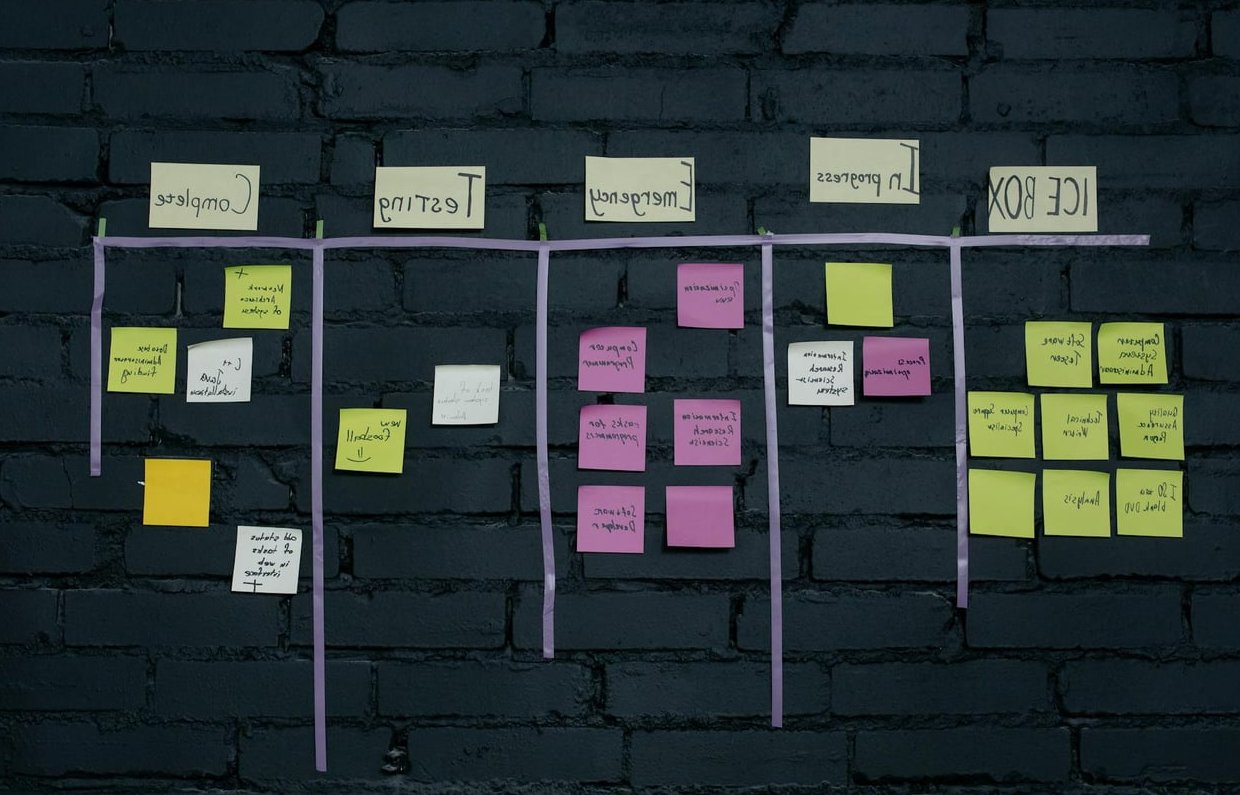
- Visualise the workflow. Every real step gets a column, including the ugly ones like “waiting for client feedback”.
- Limit work in progress (WIP). This is the non-negotiable part. No WIP limits means you have a to-do list, not Kanban.
- Manage flow. Track cycle time and throughput, not velocity points.
- Make policies explicit. Write down what “ready” and “done” mean for each column.
- Improve collaboratively. Change the system based on flow data, not vibes.
Concrete example: the same 4 people running Kanban
Same team, same people, now on a long-running SaaS product with a steady stream of feature requests and support escalations.
The board: Backlog → Ready (limit 6) → In Dev (limit 3) → Code Review (limit 2) → QA / Staging (limit 2) → Done.
Why In Dev limit 3 with 4 developers? Because the fourth person is expected to unblock a review rather than start a fifth ticket. That single constraint is what kills the “everything is 90% done” syndrome.
Their cadences:
| Cadence | Frequency | Person-hours / 2 weeks |
|---|---|---|
| Board walk (right to left, 10 min) | Daily | 6.7 |
| Replenishment meeting (30 min) | Weekly | 4.0 |
| Flow review / retro (45 min) | Monthly | 1.5 |
| Total | ~12 h out of 320 h (~3.8%) |
Less than half the ceremony cost of Scrum. The trade-off: Kanban gives you nothing for free. There is no built-in moment that forces prioritisation or reflection. If the team is not disciplined, Kanban quietly degrades into a shared to-do list with pretty columns.
Forecasting without story points
A common objection: “clients want dates, Kanban has no velocity”. In practice Kanban forecasting is often better, because it uses real historical data:
- Throughput: items completed per week (e.g. 7 per week).
- Cycle time percentiles: “85% of our tickets finish within 6 days.”
- Forecast: 40 remaining items ÷ 7 per week ≈ 6 weeks, with a confidence range.
That is a far more defensible number to put in front of a client than a velocity of “34 points” that nobody outside the team can interpret.
Scrum vs Kanban: Side by Side
| Dimension | Scrum | Kanban |
|---|---|---|
| Cadence | Fixed sprints, usually 2 weeks | Continuous flow, optional cadences |
| Commitment | Sprint Goal | Service level expectation (e.g. 85% in 6 days) |
| Core metric | Velocity, sprint burndown | Cycle time, throughput, WIP aging |
| Change mid-flight | Discouraged within the sprint | Allowed any time a slot frees up |
| Board reset | Cleared each sprint | Persistent |
| Roles required | 3 | 0 |
| Learning curve | Days to weeks, plus habit change | Minutes to understand, months to master WIP discipline |
| Handles interruptions | Poorly, unless you reserve capacity | Well, with expedite lanes and classes of service |
| Process overhead (4 people) | ~8.5% of capacity | ~4% of capacity |

The Decision Framework
Forget preferences. Answer these questions about the work, not about the team.
1. Fixed-scope client projects → lean Scrum
Signals: a signed statement of work, a delivery date, a client who needs visible progress to stay calm, scope that is mostly known up front.
Scrum wins here because the Sprint Review is a contractual-grade checkpoint. Every two weeks the client sees working software, which converts “are we on track?” anxiety into a scheduled conversation. The Sprint Goal also gives you a legitimate reason to say “we can do that, next sprint” instead of absorbing every request instantly.
Practical adaptation for 4 people:
- Merge Scrum Master into the tech lead role, but timebox it: 2 hours a week, protected.
- Replace story points with T-shirt sizes or item counts. Small teams forecast fine with throughput.
- Reserve 15 to 20% of sprint capacity for unplanned work. If you do not, every sprint fails and the team stops believing in the plan.
- Keep refinement to one 45-minute session per week, not an open-ended grooming marathon.
2. Continuous product work, maintenance or support → Kanban
Signals: no fixed end date, incoming bugs, priorities that genuinely shift weekly, mixed work types (feature, bug, infra, client request).
Sprinting here is painful. You commit on Monday, a production incident lands on Tuesday, and the sprint is fiction by Wednesday. Kanban absorbs that natively:
- Define classes of service: Expedite (one slot only, pre-empts everything), Standard, Fixed Date, Intangible (tech debt).
- Enforce a hard WIP limit per column and per person.
- Publish a cycle time percentile instead of a deadline: “standard requests are delivered within 6 working days, 85% of the time”.
3. A bit of both (most agencies and small product shops) → Scrumban
Signals: you run two client projects and maintain an internal product with the same four people.
This is where blind Scrum adoption burns teams out, because they end up with Scrum’s meeting load plus Kanban’s interrupt load.
How to Blend Them Without Ceremony Overload
Scrumban is not a cop-out, it is the most common real-world configuration on small teams. Here is a concrete setup we would recommend to a 4-person team today:
- Keep the cadence, drop the commitment. Two-week rhythm for the client demo and the retro. No sprint commitment, no sprint board reset.
- Use one persistent Kanban board with WIP limits. Work flows continuously; the demo just happens to be every second Thursday.
- Replace Sprint Planning with a weekly replenishment meeting. 30 minutes, pull the top items into Ready, done.
- Keep the Daily as a board walk, not a status round. Walk the board right to left and talk about blocked tickets, not about people. 10 minutes maximum.
- Keep the retrospective. Always. It is the single highest-ROI ceremony on a small team. 45 minutes every two weeks, with one committed action item, not five.
- Keep the review/demo. It is the moment Agile actually happens: feedback on working software.
- Drop estimation points. Slice work so most items take 1 to 3 days, then count items.
Resulting overhead: roughly 15 person-hours per two weeks, about 4.7% of capacity, while keeping both the stakeholder rhythm and the flow flexibility.
The ceremony overload test
Run this check once a quarter. For each recurring meeting, ask:
- Did a decision get made, or was it a status broadcast that could have been a board update?
- Did it change what someone does next?
- Would anyone notice if we skipped it for a month?
Any meeting that fails all three gets cut or halved. Process should be the smallest thing that keeps the work honest.

Tooling: What You Actually Need
Tooling is downstream of the method, not the other way around. A 4-person team does not need an enterprise ALM suite.
| Tool | Best fit | Notes for small teams |
|---|---|---|
| GitHub Projects | Kanban / Scrumban | Issues live next to the code, zero extra context switching. Weakest on flow analytics. |
| Jira | Scrum or Kanban | Scrum board resets per sprint; Kanban board is persistent with WIP limits and a cumulative flow diagram. Powerful, easy to over-configure. |
| Linear | Cycle-based product work | Opinionated and fast. “Cycles” are sprints without the ceremony baggage. |
| Azure DevOps | Scrum in .NET shops | Boards plus pipelines plus repos in one place. Strong if you already live in the Microsoft stack. |
| Trello / Notion | Very early stage | Fine for a board, poor for cycle time data once you grow past a handful of people. |
One rule: if your board does not reflect reality by the end of the day, the tool is not the problem. The workflow is too complicated.
Three Mistakes We See Constantly
1. Adopting Scrum to fix a people problem
Scrum will expose dysfunction, it will not fix it. If requirements are unclear and the stakeholder is absent, Scrum simply makes that visible every two weeks. That is useful, but only if someone acts on it.
2. Calling a to-do list “Kanban”
Columns without WIP limits are not Kanban. The limit is the entire mechanism. Without it, everyone starts five things, nothing finishes, and cycle time quietly triples.
3. Running Scrum ceremonies on Kanban work
Teams that sprint-plan support work spend half of every planning session re-explaining why last sprint’s plan did not survive contact with reality. Match the method to the nature of the work, not to what the last company did.

A Simple Decision Checklist
- Is the scope mostly known and the deadline fixed? Lean Scrum.
- Does more than 30% of work arrive unplanned? Kanban.
- Do you have a genuinely available Product Owner? If no, avoid full Scrum.
- Does a stakeholder need a predictable demo date? Keep a 2-week cadence, whatever else you do.
- Is the team under 5 people and drowning in meetings? Scrumban, and cut everything that does not produce a decision.
- Still unsure? Start with Kanban, add cadence only where pain appears. Adding structure is easier than removing it.
FAQ
Is Kanban Agile or Waterfall?
Kanban is Agile-compatible. It originated in Toyota’s lean manufacturing system, not in the Agile Manifesto, but its focus on continuous delivery, fast feedback and responding to change aligns directly with Agile principles. It is not Waterfall, because there are no phase gates and no requirement to finish all analysis before any build starts.
Is Scrum still relevant in 2026?
Yes, but in a lighter form than ten years ago. The trend on small teams is clear: keep the Sprint Review and the Retrospective, keep a predictable cadence, and drop estimation theatre, oversized planning sessions and point-based velocity reporting. Scrum remains the strongest option when a client or stakeholder needs a reliable rhythm of visible progress on scoped work.
What is the 3:5:3 rule in Scrum?
It is a memory aid for the Scrum framework: 3 accountabilities (Product Owner, Scrum Master, Developers), 5 events (Sprint, Sprint Planning, Daily Scrum, Sprint Review, Sprint Retrospective) and 3 artifacts (Product Backlog, Sprint Backlog, Increment). If you are not doing all eleven elements, you are doing something Scrum-inspired, which is perfectly fine as long as you are honest about it.
What are the main types of Agile methodologies?
The most widely used are Scrum, Kanban, Scrumban, Extreme Programming (XP), Lean Software Development, Crystal and Feature-Driven Development. Scaling frameworks such as SAFe and LeSS exist too, but they solve coordination problems between many teams and are overkill for a squad of four.
Can one team run Scrum and Kanban at the same time?
Yes, and it is common in agencies. A typical pattern is a Scrum-style cadence for the client project plus a Kanban lane with a strict WIP limit for support and maintenance. The key is capacity protection: decide in advance what percentage of the week belongs to each stream, and respect it.
Which has less overhead for a 4-person team?
Kanban, by roughly half. Expect around 4% of capacity in cadences for Kanban versus 8 to 9% for by-the-book Scrum. Scrumban typically lands near 5%, which is the sweet spot for most small teams delivering both client and product work.
Final Word
There is no winner in the agile vs scrum vs kanban comparison because they are not competitors. Agile is the value system. Scrum buys you predictability in exchange for ceremony. Kanban buys you flexibility in exchange for discipline. Pick based on the shape of your work, measure the result in cycle time and delivered value, and be ruthless about removing any ritual that no longer earns its place.
At coding4.net we run exactly this hybrid model on small, senior teams: a persistent board with WIP limits, a two-week demo rhythm for clients, and a retrospective nobody is allowed to skip. If you want a second opinion on how your team is organised, get in touch.